Vetting an SMP Practitioner: The Five Sterility Standards
The difference between an aesthetic failure and a working optical hair illusion is not artistic talent; it is adherence to five clinical baselines. The deck behind this guide sets them out as a practitioner framework: a clinical environment, absolute sterility, material integrity, verified expertise, and board oversight. Four of the five are documentary, which means a Naperville client can verify them before a session rather than after. The fifth sets a hard threshold: the practitioner should possess more than one year of SMP-specific experience and a verifiable clinical portfolio. This is written for people around Naperville, IL who are looking into hair restoration blog and want the honest version rather than a sales page.
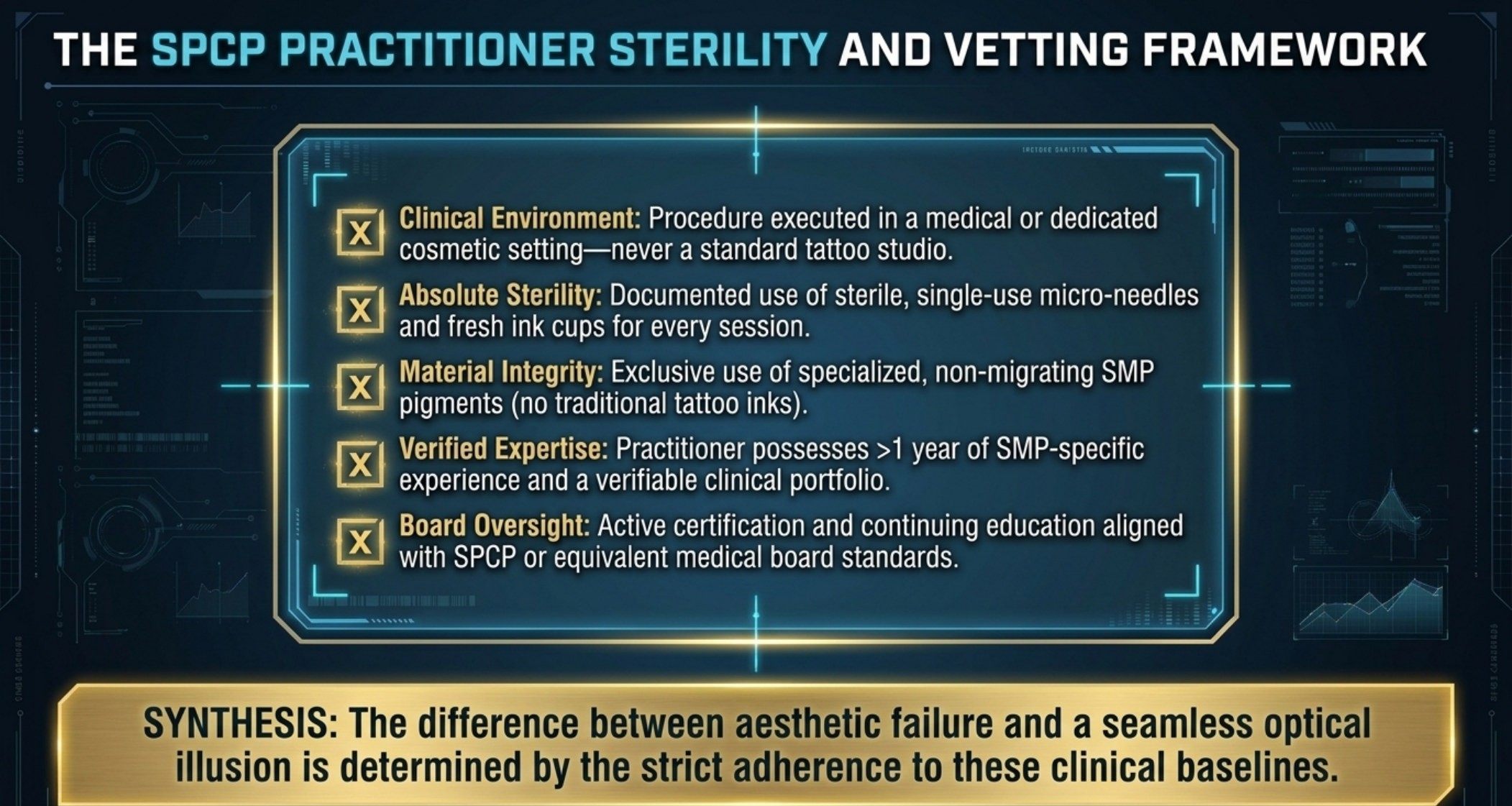
That threshold matters because the framework is a filter, not a list to admire. Each standard has pass-or-fail evidence attached to it, and the evidence is what separates a provider who follows the baselines from one who only describes them. The process walkthrough shows where each standard lands in the treatment sequence.
Standard one: the clinical environment
The deck's first baseline is that the procedure is executed in a medical or dedicated cosmetic setting — never a standard tattoo studio. This is not a matter of taste. The environment determines whether the sterility and material standards downstream of it can be maintained at all, and a setting built for conventional tattooing is built around deep penetration, large needles, and standard inks, which are the exact conditions SMP is designed to avoid.
The vetting question is direct: where is the procedure performed, and what else happens in that space? A dedicated clinical room answers both, and it is the baseline against which the remaining four standards are even physically possible.
Standard two: absolute sterility
The second baseline is documented use of sterile, single-use micro-needles and fresh ink cups for every session. The word documented is doing the work. Reusable equipment is not automatically unsafe, but it is unverifiable from the client's chair, whereas single-use consumables make the claim checkable in the room. For a Naperville case, this is the standard that answers the highest-severity risk on the deck's own clinical dashboard — pathogen exposure, whose trigger is unsterile equipment.
| Standard | Requirement | Pass-or-fail evidence |
|---|---|---|
| Clinical environment | Medical or dedicated cosmetic setting, never a standard tattoo studio | Physical site of the procedure |
| Absolute sterility | Sterile, single-use micro-needles and fresh ink cups every session | Documented consumables |
| Material integrity | Specialized, non-migrating SMP pigments; no traditional tattoo inks | Pigment brand and line, named |
| Verified expertise | >1 year SMP-specific experience and a verifiable portfolio | Completed clinical cases |
| Board oversight | Active certification and continuing education aligned with SPCP or equivalent | Externally verifiable credential |
Standard three: material integrity
The third baseline is exclusive use of specialized, non-migrating SMP pigments — no traditional tattoo inks. This is the standard that governs everything downstream on the safety side. Non-migrating micro-pigments are what keep the deposit suspended in the upper dermal layer rather than spreading into the blowout pattern, and the deck's material spec excludes standard inks specifically because their migration behaviour is incompatible with a follicle illusion.
It is also the standard that removes a low-probability risk at the source: the deck traces MRI interference to iron oxide traces in substandard pigments, so correct sourcing closes that entry before it becomes a case question. The vetting move is to ask for the pigment brand by name and confirm it is an SMP-specific, non-migrating line.
| Property | SMP micro-pigment | Traditional tattoo ink |
|---|---|---|
| Target layer | Upper dermal layer only | Deep penetration |
| Needle class | Micro-needles | Large needles |
| Migration behaviour | Zero migration | Migration and bleed risk |
| Pigment type | Specialized, non-color-shifting micro-pigment | Standard ink |
| MRI interference risk | Trigger removed by correct sourcing | Iron oxide traces in substandard pigment |
Standard four: verified expertise
The fourth baseline sets a measurable floor: the practitioner possesses more than one year of SMP-specific experience and a verifiable clinical portfolio. A portfolio is the operative evidence, because SMP outcomes are depth-dependent, and only a body of completed cases demonstrates that a practitioner consistently lands the deposit in the upper dermal layer rather than at the epidermal boundary above it or the subcutaneous tissue below.
One year is a floor, not a target, and it is worth reading as the minimum bar the deck is willing to state out loud. Applied to a Naperville search, the question is not whether a practitioner has years of tattooing behind them, but whether those years are SMP-specific, because the depth control that decides a result is a narrower skill than general tattoo work.
| Credential | Threshold | Why it filters |
|---|---|---|
| SMP-specific experience | More than 1 year | General tattooing does not evidence depth control |
| Clinical portfolio | Verifiable and complete | Demonstrates consistency across cases |
| Certification | Active, SPCP or equivalent | The only externally verifiable claim |
| Continuing education | Current and aligned to board standards | Evidence the skill is maintained |
Standard five: board oversight
The fifth baseline requires active certification and continuing education aligned with SPCP or equivalent medical board standards. Certification is the only standard on the list that is externally verifiable rather than self-reported, which makes it the cheapest check in the entire framework. A practitioner whose credential can be confirmed against an external standard is also a practitioner whose other four claims are easier to accept.
| Order | What to verify | Why it comes at this point |
|---|---|---|
| 1 | Certification and continuing education | Externally checkable before any contact |
| 2 | Clinical environment | Visible on a site visit |
| 3 | Sterility consumables | Confirmable by documentation at the session |
| 4 | Pigment brand and line | Named product, sourced by the provider |
| 5 | Portfolio and experience | Requires review of completed cases |
Running the five standards as a filter
Ordered by verifiability, the framework narrows a shortlist quickly: certification first, because it is public; clinical environment and sterility second, because they are visible on a site visit; material integrity third, because it is a named product; portfolio last, because it takes time to review. A provider who clears all five has closed the gap between advertising and practice, and the deck's closing point is exactly that — the difference between an aesthetic failure and a working illusion is adherence to these baselines, not marketing.
The tools hub carries the practitioner safety checklist for working through the five in order, and the comparison guides place SMP against surgical alternatives on the same criteria. This article is educational information, not medical advice, and a qualified provider should assess the individual case.
Frequently Asked Questions
How much SMP experience should a practitioner have?
The deck's baseline is more than one year of SMP-specific experience plus a verifiable clinical portfolio. General tattooing experience does not satisfy it, because depth control in the 0.3-to-0.5 mm band is a different skill from conventional tattoo work.
Is certification actually necessary for SMP?
The framework requires active certification and continuing education aligned with SPCP or equivalent medical board standards. It is the only standard on the list that can be verified externally, which makes it the fastest filter when shortlisting in Illinois.
What should I ask about the equipment?
Ask for documentation of sterile, single-use micro-needles and fresh ink cups for every session, and confirm the procedure is performed in a medical or dedicated cosmetic setting rather than a standard tattoo studio. Those two answers cover the highest-severity risk on the deck's own dashboard — pathogen exposure from unsterile equipment.
Get matched with hair restoration professionals →
Ready for a Professional Review?
We can connect you with qualified hair restoration professionals who can map your situation to the right treatment.
Get Matched with Hair Restoration Professionals