SMP Sessions and Longevity: The 7-to-32-Month Timeline
Scalp micropigmentation is sold two ways: as a single appointment, or as a phased protocol with a defined horizon. The clinical version is the second. The deck behind this guide specifies four sessions, with sessions two and three spaced one week apart, a fourth visit serving as a touch-up at one month, and 2 to 4 hours of chair time per session. The result is then tracked across a 7-to-32-month window in which the deck records minimal fading, and it is classified as semi-permanent to permanent cosmetics rather than a tattoo. That 7-to-32-month band is the figure to hold onto when a Naperville quote promises a permanent result from a single sitting. This is written for people around Naperville, IL who are looking into hair restoration blog and want the honest version rather than a sales page.
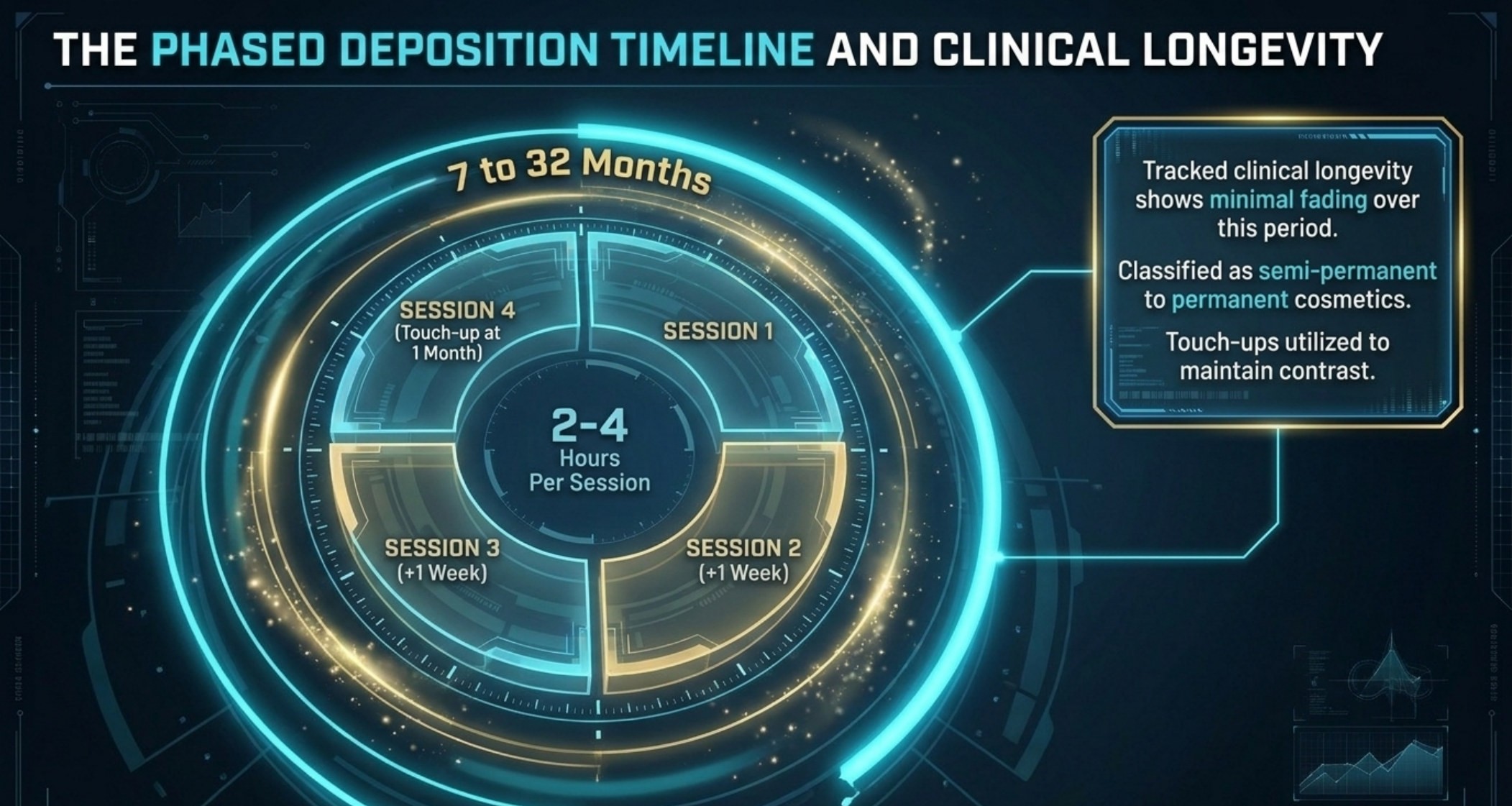
The schedule is not padding. Touch-ups are the mechanism that maintains contrast as pigment settles into the upper dermis, and the one-week spacing between sessions lets the practitioner read how the skin is holding each deposit before the next layer goes down. Where a provider collapses the protocol into one long session, the trade-off is not speed but contrast retention across the following year. Anyone in Naperville weighing this against surgical restoration can read the wider SMP science and safety overview alongside the process walkthrough before booking.
Why the protocol runs four sessions across roughly five weeks
Session one establishes the base density layer across the treatment area. Sessions two and three, each one week later, build the mid-tone density and correct the first pass. Session four is the touch-up at one month, timed after initial healing settles so the practitioner can read true contrast rather than the immediate post-session appearance. Each visit runs 2 to 4 hours, and that per-session time budget is exactly why a full scalp case cannot be compressed into a short appointment without thinning the density the illusion depends on.
The pigment-density specification on the deck sits at 250 to 258 micro-dots per cm². That figure is what makes the phased approach necessary: density is delivered in passes rather than one heavy deposit, because evenly distributed micro-dots read as follicle shadow while a single dense pass reads as a flat block of ink. The four-session structure is the delivery method for that specification, not an upsell layered on top of it.
| Visit | Timing | What it does |
|---|---|---|
| Session 1 | Initial appointment | Establishes base density across the treatment area |
| Session 2 | +1 week | Builds mid-tone density; first correction pass |
| Session 3 | +1 week | Completes density; second correction pass |
| Session 4 | Touch-up at 1 month | Restores contrast after the first healing cycle settles |
The 0.3-to-0.5 mm depth that decides how long the result lasts
Longevity is set before the first session, by depth. The optical illusion the deck describes exists only in the upper dermal layer. Deposit too shallow and pigment sits in the epidermis, where it sheds rapidly. Deposit too deep and it reaches subcutaneous tissue, where it spreads and blurs into the blowout pattern. The working depth cited is 0.3 to 0.5 mm, the band the deck labels dermal suspension.
This is the dividing line between SMP and a conventional tattoo. A standard tattoo uses deep penetration, large needles, and high ink loads, and accepts migration and bleed as normal. SMP restricts pigment to the upper dermal layer with micro-needles and specialized, non-color-shifting micro-pigments the deck describes as zero-migration. The trade-off is precision: the technique demands finer needle control, which is also why the 7-to-32-month figure is presented as a tracked range rather than a guarantee.
| Deposition depth | Result | Failure mode |
|---|---|---|
| Too shallow (epidermis) | Pigment sits above the target layer | Rapid shedding |
| Optimal (upper dermis, 0.3-0.5 mm) | Dermal suspension | None within spec |
| Too deep (subcutaneous) | Pigment spreads below the target layer | Blowout / blurring |
| Standard tattoo contrast | Deep penetration, large needles, high ink load | Migration and bleed risk |
| SMP contrast | Upper dermal layer only, micro-needles, zero migration | Non-color-shifting micro-pigments |
Reading the 7-to-32-month window honestly
The lower end of the window belongs to cases where pigment is held near the epidermal boundary and fades faster; the upper end belongs to cases deposited inside the optimal 0.3-to-0.5 mm band with touch-ups completed on schedule. The deck frames this as a range, not a promise, and that matters when a provider quotes a single number with no band attached.
Two variables move a case along the band. The first is depth control: cases inside the optimal band cluster at the longer end. The second is whether the fourth visit actually happens. The touch-up at one month is the mechanism that maintains contrast, so skipping it pushes a case toward the shorter end of the range even when the first three sessions were executed well.
| Metric | Deck value | What it means for a plan |
|---|---|---|
| Tracked longevity | 7 to 32 months | A range to budget against, not a fixed term |
| Fade rate over that window | Minimal fading recorded | Contrast holds longer inside the optimal depth band |
| Cosmetic classification | Semi-permanent to permanent | Distinct from a true permanent tattoo |
| Contrast maintenance | Touch-ups | The one-month visit is the maintenance mechanism |
| Chair time per visit | 2 to 4 hours | Caps how much density one session can deliver |
What the timeline means for a Naperville decision
Read as a project plan, SMP is five weeks of defined visits and a 7-to-32-month result horizon, with contrast maintained by touch-ups rather than by one permanent deposit. Illinois clients comparing this with surgical restoration should map the SMP window against the recovery and growth timelines of a transplant; the two run on very different clocks, and a shorter window is not automatically a worse outcome if the goal is a density illusion rather than new growth.
The window also sets the maintenance budget. A 7-to-32-month result means the case does not end at session four, and a provider who quotes only the initial protocol is quoting the setup rather than the full term. The decision tools hub scores each route against a personal case, and the SMP science overview carries the underlying safety picture. This article is educational information, not medical advice, and a qualified provider should assess the individual case.
Frequently Asked Questions
How many SMP sessions does the protocol take, and how far apart?
Four in the deck's protocol: the first appointment, a second and third session one week apart, and a fourth visit acting as a touch-up at one month. Each session runs 2 to 4 hours.
How long does an SMP result actually last?
The deck tracks clinical longevity across a 7-to-32-month window with minimal fading and classifies the outcome as semi-permanent to permanent cosmetics. Position within that band depends on depth control and whether the one-month touch-up is completed.
Why not complete SMP in a single session?
Because density is delivered in passes at a specification of 250 to 258 micro-dots per cm², and one-week spacing lets the practitioner read how the skin holds each deposit. Compressing the protocol trades contrast retention, not speed, and the touch-ups exist specifically to maintain that contrast.
Get matched with hair restoration professionals →
Ready for a Professional Review?
We can connect you with qualified hair restoration professionals who can map your situation to the right treatment.
Get Matched with Hair Restoration Professionals